Leave Your Message

What Is the Best Motorcycle Car Lift from China?

Choosing the best Motorcycle Car Lift from China requires more than comparing prices or polished product photos. A reliable lift must support motorcycles steadily, raise vehicles smoothly, and protect technicians from avoidable risks. Buyers should examine rated capacity, platform dimensions, lifting height, locking systems, hydraulic components, and emergency lowering features. Small details matter, such as anti-slip plates, wheel chocks, welded joints, and accessible maintenance points.

Chinese manufacturers offer many lift designs for repair shops, dealerships, and private garages. Some factories provide strong engineering support and consistent quality. Others may change components without clearly updating the specification sheet. That difference can become expensive. A serious supplier should share load-testing records, material details, factory photographs, manuals, and product inspection reports. Independent verification is still valuable, even when the documents look complete.

The “best” choice depends on the motorcycle types, workspace, budget, and expected daily workload. A compact scissor lift may suit a small workshop, while a wider platform may better support touring motorcycles or larger service tasks. Ask for a sample inspection or a live factory demonstration when possible. Check packaging, spare-part availability, installation guidance, and after-sales response before placing a large order. I have seen buyers focus heavily on lifting capacity and overlook platform stability. That is a mistake worth reconsidering. A lower-priced lift can become a poor investment if its locks, seals, or control box fail early. Careful comparison creates a safer, more dependable purchase.
What Is the Best Motorcycle Car Lift from China?

Types of Motorcycle Car Lifts Manufactured in China

What Is the Best Motorcycle Car Lift from China?

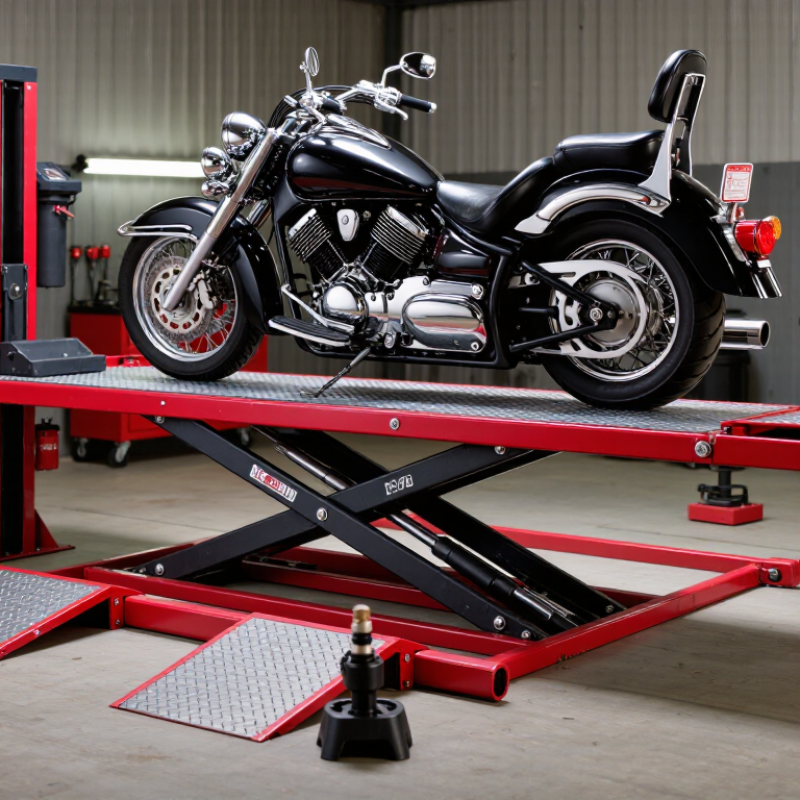
Chinese manufacturers produce several motorcycle car lift types, each suited to different workshop conditions. Hydraulic scissor lifts are common because they provide stable support and require limited floor space. Motorcycle table lifts usually support 450–680 kilograms, while wider vehicle platforms can handle more than 2,000 kilograms. Pneumatic lifts offer smooth movement, but they depend on a reliable air compressor. Portable folding lifts save space, although their smaller platforms may feel less stable during heavy repairs.

According to Fortune Business Insights’ 2024 Automotive Lift Market report, the global market is expected to grow at roughly 5% annually. Hydraulic systems remain a major technology segment. This trend explains why Chinese factories continue investing in welded frames, hydraulic cylinders, safety locks, and load testing. The better suppliers test lifts beyond their rated capacity and inspect weld penetration, platform deflection, and emergency lowering performance.

Ask for test records. Not just product photos.

For mixed motorcycle and car service, a full-width hydraulic platform is usually more practical than a narrow motorcycle table. Wheel chocks, adjustable tie-down points, anti-slip plates, and mechanical locking positions improve daily safety. EN 1493 is a useful reference when checking vehicle-lift design and documentation.

However, compliance claims need verification through certificates and factory records. A low quotation can hide thinner steel or weaker seals. I have seen attractive specifications fail to explain uneven workshop floors, which remains a real limitation.

Key Features That Define a High-Quality Motorcycle Lift

What Is the Best Motorcycle Car Lift from China?

A high-quality motorcycle lift begins with verified load capacity, not attractive paint. The Automotive Lift Institute recommends testing rated capacity with a safety margin. Buyers should also check welded joints, platform thickness, and hydraulic leakage control. In my workshop experience, a stable platform matters more than extra accessories. A narrow deck can make a heavy touring motorcycle feel nervous. It happens quickly.

The 2024 Global Automotive Lift Market report by Grand View Research identifies hydraulic systems, safety locks, and workshop efficiency as major purchasing factors. These findings match practical inspections. A reliable lift should include mechanical locking positions, an anti-slip surface, wheel chocks, and a pressure-resistant hydraulic circuit. The platform should remain level during raising. Uneven movement usually suggests poor alignment or weak maintenance planning. The exact rated load must exceed the motorcycle’s total weight, including tools and accessories.

European Standard EN 1493:2010 also emphasizes structural stability, emergency lowering, and protection against unintended descent. Buyers sourcing from China should request factory load-test records, material certificates, and clear installation instructions.

ISO 9001 certification can support process reliability, but it does not replace product testing. That distinction is easy to miss. Some suppliers publish impressive specifications, yet omit cycle-test results. I would inspect those gaps carefully before ordering. A good lift is quiet, predictable, and boring in daily use. That is usually a positive sign.

How to Compare Chinese Motorcycle Car Lift Manufacturers

Choosing the best motorcycle car lift from China starts with comparing manufacturers, not catalog photos. A reliable supplier should provide clear load ratings, platform dimensions, lifting height, and hydraulic system details. Ask whether these figures come from testing or simple design estimates. A useful specification sheet includes steel thickness, weld methods, motor power, safety locks, and recommended maintenance intervals.

A factory audit can reveal more than a polished website. Check production records, inspection procedures, and the consistency of finished welds. Request a video showing a loaded lift rising, stopping, and locking safely. Independent load testing is valuable, especially when the lift will serve workshops every day. Certification documents should be traceable and suitable for your target market. Do not accept vague claims.

Communication also separates strong manufacturers from weak ones. Compare response times, technical drawings, packaging methods, spare-part availability, and warranty terms. Ask for installation instructions with real photographs, not only translated diagrams. I would also test one sample before placing a larger order. It costs more initially, but it may expose noisy pumps, uneven platforms, or difficult controls. My own comparison checklist is not perfect; I once focused too heavily on price and overlooked replacement seal availability. That mistake changed how I assess long-term value. A slightly higher quotation may reflect thicker steel, better testing, and more dependable support.

What Is the Best Motorcycle Car Lift from China? - How to Compare Chinese Motorcycle Car Lift Manufacturers

The table below provides a practical, brand-neutral comparison framework. The figures are typical industry reference ranges and should be verified against the manufacturer’s drawings, test reports, certificates, and final quotation.

Comparison Dimension Typical Motorcycle Lift Typical Vehicle Lift Recommended Manufacturer Benchmark Documents or Evidence to Request
Rated lifting capacity 450–1,500 kg 2,700–4,000 kg for common workshop models Select a rated capacity at least 20% higher than the heaviest intended load. Rated-load test report, product specification sheet, and load-rating plate.
Platform length 1,800–2,400 mm 4,000–5,200 mm for passenger vehicles The usable platform should exceed the vehicle wheelbase or motorcycle length with adequate clearance. Dimensioned engineering drawing showing usable platform length.
Platform width 600–1,000 mm 2,500–3,000 mm overall width, depending on the design Check wheel-track compatibility, side clearance, and the available installation area. Overall-size drawing, installation layout, and floor-clearance requirements.
Minimum platform height 100–200 mm for many surface-mounted designs 100–180 mm for many surface-mounted designs A lower entry height reduces ramp angle and improves access for low-clearance vehicles. Technical drawing, ramp dimensions, and access-height measurement.
Maximum lifting height 750–1,200 mm 1,600–2,000 mm for many two-post or scissor designs Compare the working height with technician height, ceiling height, and the service task. Stroke diagram, maximum-height drawing, and ceiling-clearance calculation.
Lifting mechanism Single or dual hydraulic cylinder; scissor or table configuration Two-post, four-post, scissor, or in-ground hydraulic configuration Choose a design with synchronized lifting and positive mechanical support locks. Hydraulic circuit diagram, synchronization method, and safety-lock drawings.
Safety system Mechanical locks, wheel vise, safety stop, and anti-slip platform Mechanical locks, arm restraints, door protection, and hose-burst protection Safety locks should operate independently of hydraulic pressure and engage throughout the lifting range. Risk assessment, safety-function description, and overload or hose-burst test results.
Applicable technical standards EN 1493 may apply to vehicle lifting equipment; electrical parts may reference IEC 60204-1. EN 1493, ISO 12100, and applicable local electrical and machinery requirements The manufacturer should identify the exact standard edition and the scope of conformity. Declaration of conformity, test reports, risk assessment, and certificate scope.
Steel structure Welded structural steel with reinforced platform sections Welded columns, arms, runways, or reinforced scissor frames Compare steel grade, section thickness, weld quality, and calculated deflection rather than steel weight alone. Material certificates, welding procedure, weld-inspection records, and structural calculations.
Surface protection Powder coating or painted steel; galvanized parts may be available Powder coating, painted steel, or galvanized components Require documented surface preparation and coating thickness suitable for the installation environment. Coating specification, surface-preparation procedure, and salt-spray test results when required.
Hydraulic system Hydraulic power unit with pressure relief and controlled lowering Higher-capacity hydraulic pump, cylinders, hoses, and flow-control valves Verify rated pressure, leak testing, emergency lowering, and the availability of replacement seals and hoses. Hydraulic component list, pressure-test record, and maintenance instructions.
Electrical compatibility Common configurations include 220–240 V single-phase or 380–415 V three-phase, 50 Hz. Common configurations include 220–240 V single-phase or 380–415 V three-phase, 50 Hz. The power supply, motor rating, plug type, protection class, and control voltage must match the destination market. Wiring diagram, electrical component ratings, and destination-country requirements.
Factory quality control Dimensional inspection, weld inspection, hydraulic test, and functional test Dimensional inspection, weld inspection, load test, synchronization test, and functional test Prefer documented inspection at incoming, in-process, and final-production stages. Quality-control plan, final inspection report, factory audit records, and serial-number traceability.
Customization capability Platform size, wheel vise, ramp, extension, and control-panel options Arm length, runway length, drive-through configuration, height, and power options Custom changes should be supported by revised drawings and a confirmed load calculation. Approved technical drawing, change list, revised quotation, and prototype or sample-test record.
Installation requirements Often suitable for surface installation, subject to floor strength and levelness May require reinforced concrete, anchor bolts, minimum slab thickness, and ceiling clearance The supplier should provide floor-load data, anchor details, and installation tolerances. Foundation plan, anchor-bolt layout, floor-load requirement, and installation manual.
Spare-parts support Common replacement items include seals, hoses, rollers, locks, and switches. Common replacement items include cylinders, hoses, rollers, cables, locks, and control components. Parts should be identified by standard specifications or clear drawings, not by an internal code only. Spare-parts list, exploded diagram, recommended stock list, and response-time commitment.
Warranty and after-sales service 12–24 months is a common commercial warranty range 12–24 months is a common commercial warranty range Compare warranty scope, exclusions, remote support, installation guidance, and spare-parts availability. Written warranty terms, service procedure, troubleshooting guide, and support contact process.
Packaging and shipping Steel frame with protective wrapping, cartons, or export wooden cases Usually shipped in sections or knocked-down parts with protected hydraulic and electrical components Compare packed dimensions, gross weight, container utilization, and moisture protection. Packing list, loading photos, package dimensions, gross weight, and applicable wood-treatment records.
Total purchase value Equipment price plus freight, duties, installation, and spare parts Equipment price plus freight, foundation work, installation, duties, and commissioning Compare total landed cost and five-year operating cost instead of purchase price alone. Itemized quotation, shipping terms, installation cost, consumables, and estimated maintenance cost.

Evaluation tip: The best supplier is not necessarily the one offering the lowest price. Prioritize verified load capacity, independent safety features, complete technical documentation, stable quality control, compatible electrical specifications, and dependable spare-parts support.

Safety Standards and Load Capacity to Check Before Buying

Choosing the best motorcycle car lift from China starts with safety evidence, not price or painted steel. EN 1493:2010 identifies vehicle-lift risks involving stability, crushing, and unintended descent. ANSI/ALI ALCTV:2017 also provides a useful benchmark for lift design and verification. Ask the supplier for test reports, rated-load documentation, weld inspection records, and clear instructions in English.

Load capacity must include the motorcycle, fuel, luggage, accessories, and working forces. A 220-kilogram motorcycle may need a lift rated well above 220 kilograms, but no universal “safe multiplier” replaces the manufacturer’s engineering data. Check the actual platform rating, not only the hydraulic pump rating.

The frame, ramp, wheel chock, and locking system must support the same load. Do not guess.

Mechanical locks matter more than hydraulic pressure. Look for positive locking positions, an overload valve, emergency lowering, anti-slip decking, and guards around pinch points. The U.S. Bureau of Labor Statistics reported 885 fatal workplace injuries from falls, slips, and trips in 2023. That figure covers many industries, yet it shows why a small height-related failure deserves serious attention.

In practical inspections, I would place the motorcycle centrally, secure both wheels, and test the lift at low height before raising it fully. Small details matter. A missing locking pin can outweigh an attractive specification sheet. I would also recheck Chinese test certificates against the stated model, serial number, and applicable standard, because paperwork alone can be incomplete.

How to Choose the Best Motorcycle Car Lift for Your Needs

Choosing the best motorcycle car lift from China starts with your vehicle, not the product photo. Measure garage width, loading height, wheelbase, and usable floor area. A compact lift may block a hatchback door or sit too high for your ramp. Check rated capacity with a safety margin. Include luggage, fuel, and accessories in your calculation. Small details matter.

Compare lifting methods carefully. A hydraulic model may provide smooth movement and strong holding power. A powered model can reduce effort during repeated loading. When sourcing from China, request the minimum height, maximum height, locking positions, and emergency lowering method. A reliable supplier should provide load-test records, material specifications, instructions, and replacement-part information. Inspect welds, wheel chocks, ramps, and tie-down points. Bolts should remain accessible. Look for stable contact with the car floor.

I once focused too much on lifting speed and overlooked storage space. That was a poor choice. For home use, test the lift unloaded and loaded, then watch for sway, noise, or uneven descent. Recheck fasteners after the first few cycles. If the car floor flexes, stop and reassess the support design. Ask how often seals, cables, and casters require inspection. Certificates help, but clear test methods matter more than impressive wording. A slightly heavier lift may be easier to trust and maintain over time.